The World Cup is over. As expected, England got knocked out in the semi-finals, Spain sailed to victory and Infantino has managed (somehow) to keep his job. But as the “greatest show on Earth” comes to a close, the return of club football is now only days away. Fans up and down the country are no longer talking about the closing ceremony, but are instead returning to an age-old question which has blighted the Premier League for decades: club finances.
It is notoriously difficult to effectively measure football club finances in the modern age. But in this month’s Substack the Beauhurst Insights team wanted to measure how much of an impact balance sheets have on a club’s success, ranging from relegation battles to silverware.
Using Beauhurst data, we analysed the financial statements of clubs that have played in the Premier League since 2015/16, linking approximately 200 club-seasons to league results, relegation, European qualification and major domestic and European trophies. The results suggest that money does matter. But the relationship between spending and success is more complicated than us fans might think.
Player assets, turnover and league position
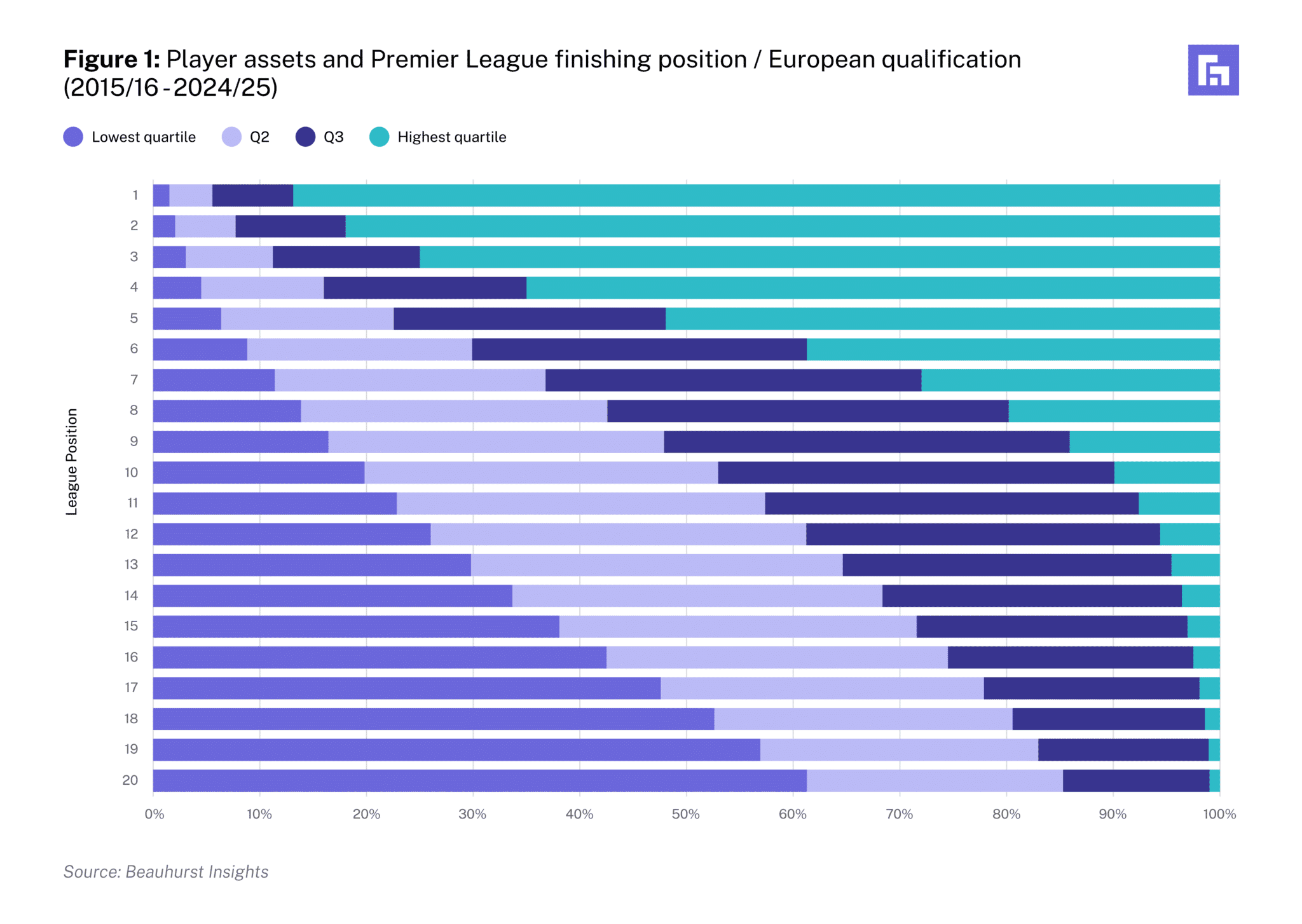
The first finding is straightforward: clubs with larger player asset bases tend to finish considerably higher up the Premier League. Since the 2015/16 season, clubs in the highest quartile for intangible assets (often associated with the value of players bought by a club) finished in an average position of around 4.5th, compared with approximately 14.6th for clubs in the lowest quartile.
The gap becomes even more pronounced when looking at qualification for Europe. Around 80% of club-seasons in the highest player-asset quartile resulted in a top-six finish, compared with just 6% among clubs in the lowest quartile.
This does not necessarily mean that simply buying more players causes a club to rise up the table. The Premier League’s largest clubs also generate considerably more revenue, allowing them to sustain bigger squads, higher wages and larger transfer commitments year after year. Indeed, turnover remains one of the strongest predictors of league performance in our analysis. Clubs in the highest turnover quartile averaged around 74 points and a fourth-place finish, with approximately 85% finishing in the top six.
The financial divide is therefore about scale as much as spending. Clubs consistently competing for European football operate with fundamentally larger economic and playing asset bases than most of the division.