Over the course of the past eight years female entrepreneurs have made significant inroads into raising equity finance, a world that has traditionally been – and remains to be – dominated by men. The overall trajectory of funding into businesses with at least one female founder since 2011 remains positive, but progress is slow and inconsistent. 2018 has been a mixed bag, with a decrease in the percentage of deals going in to these companies, but a record high for the average deal size secured by women entrepreneurs.
In total, £570m was invested across 254 deals into female-founded companies in 2018, down from £650m across 304 deals in 2017. As we’ve seen in previous stories in The Deal, there was a slump in both size and number of equity investments across the market in 2018, but male-founded companies only saw a 6% decrease in deal numbers, compared to 15% for female entrepreneurs. Only 16% of 2018’s equity deals went into female-founded companies, compared to 18% in 2016.
Percent of deal numbers, female-founded businesses
But women saw less of a decline in investment amounts, with a 12%
decrease, compared to the 17% decrease experienced by men. Female entrepreneurs secured an 8% share of the amount of equity invested, down from 13% in 2015 and 2016, but on par with 2017. Most encouragingly, average deal size hit a new record, increasing from £2.22m to £2.33m in 2018. Of course, this still far below that for male-founded companies, who achieved an average deal size of £5.43m.
Percent of total amount raised, female-founded businesses
Citing the increase in the number of support systems put in place for female founders in the past few years, Navidski is optimistic that 2019 will be a more positive year, as the impact of these initiatives start to reflect in investment figures. But she maintains that the general perception that the male-dominated VC scene is aggressive and gender biased will continue to impact this progress.
“For women, entrepreneurship is about freedom and independence, and many consider traditional venture capital to be incompatible with this”. She acknowledges that shifting the perception of the industry will take time and a concerted effort from established VCs, who are often focused on chasing unicorns and rapid growth at any cost. “But the biggest change will be prompted by new industry players who can provide an environment that female founders can trust and relate to – and the ecosystem is more than ready for it”.
Who is investing in companies founded by female entrepreneurs
LocalGlobe tops the list of fund managers most frequently investing in female founded companies, with 7 investments in 2018. They participated in an £8.6m growth stage round into market analytics company Streetbees, a company they have supported since 2015. Streetbees have also secured investments from three of the other ranked fund managers; Octopus, Atomico and BGF.
Percent of deal numbers, female-founded businesses
Founder and CEO, Tugce Bulut, notes that she has been very lucky to receive a range of support throughout Streetbees’ fundraising journey. “As one of the few female founders in the tech sector, I feel very responsible for helping nurture the next generation of female entrepreneurs, so they can find their way through the VC jungle.”
What support is available for women entrepreneurs?
Indeed, more and more support networks and organisations are cropping up. From AllBright Collective, who support women to achieve their career ambitions, to Diversity VC, who are dedicated to creating a fairer and more diverse venture capital industry; and sector specific initiatives like accelerateHER, a programme which addresses the under-representation of women in technology. In 2018, they launched Male Champions of Change in Global Technology to enable male CEOs, founders and c-suite leaders to step up beside women to create a more gender equal future, and shift the conversation from equality as a ‘women’s issue’ and instead tackle the systemic failings in the industry.
We’ve also seen the rise of female-led investment bodies, such as the female focussed angel network Angel Academe and VC firm Voulez Capital. Founded by Anya Navidski in May 2018, Voulez Capital invests between £500k and £2m into female-founded businesses across Europe – and invested into two UK companies in 2018. This includes leading a $1m round in Sciapps, the creators of SkinNinja.
This company is bringing much needed clarity and transparency to the skincare market by giving customers an informed understanding of the ingredients in their products, and offers suggestions for alternatives that are less harmful.
Where is funding coming from?
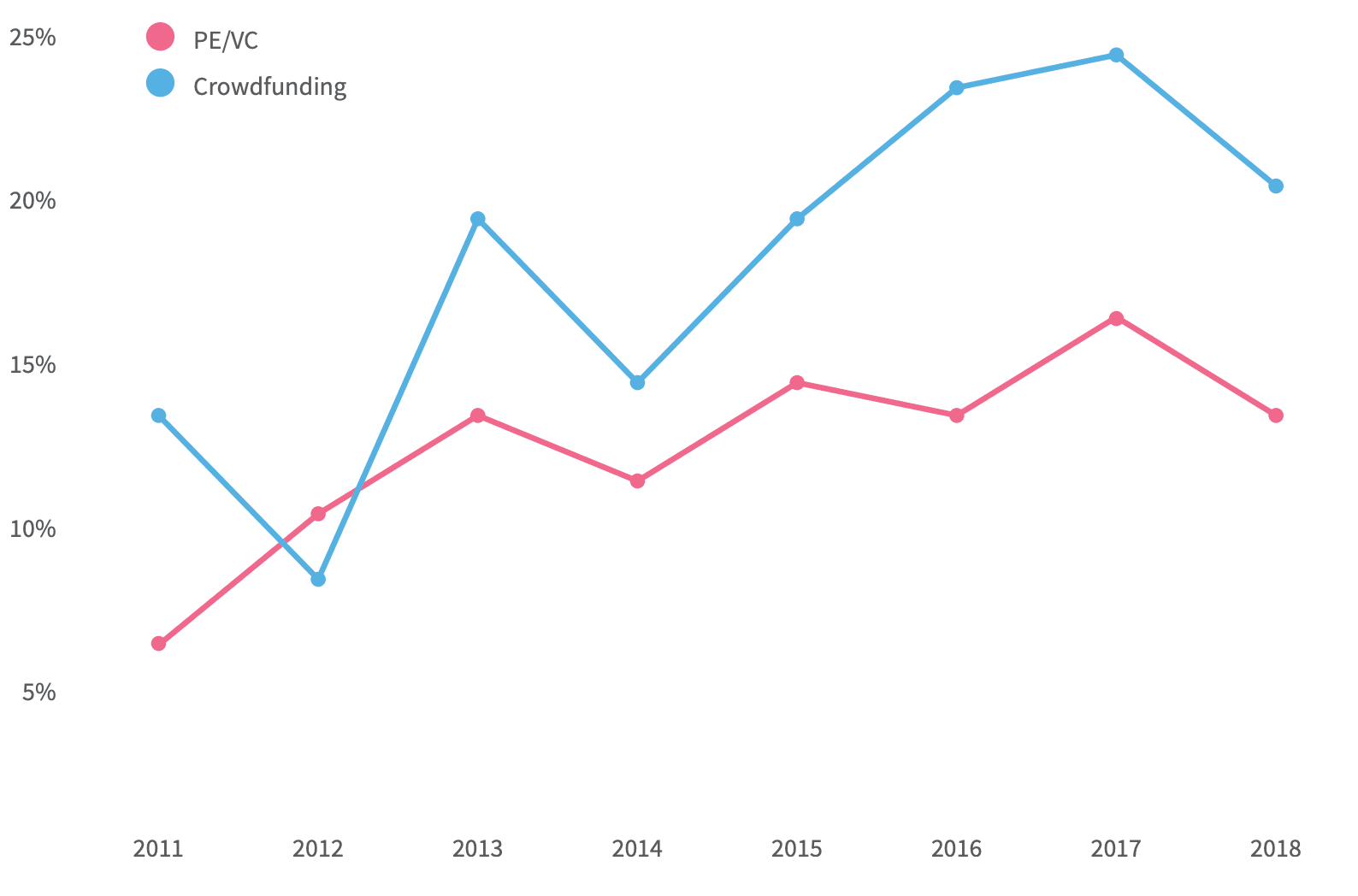
This account of women having a cynical impression of venture capital is borne out when we compare funding sources. Whilst the overarching patterns remain similar, there is variation in the percentage of deals secured from different types of funds. Female-founded businesses secured only 13% of VC deals in 2018, compared to 20% of crowdfunding investments.