Equity Investment and UK Spinout Survival

Words Callum Newton

Equity Investment and UK Spinout Survival

The role of equity investment in determining the life and death of spinouts

The UK has a well deserved reputation as a global leader in research and innovation. With world class universities and a strong technical talent pool, Britain consistently produces ideas that shape the global economy.

However turning those ideas into successful, scalable business ventures remains a persistent challenge for founders and policy wonks alike. While the UK excels at generating intellectual property, many of its most promising companies struggle to translate this into long-term commercial success.

This is particularly true amongst university spinouts. The UK is a great place to start a business, but this advantage quickly fades once a founder wants to scale-up activity as domestic capital becomes both increasingly important and scarce. Many firms ultimately look overseas for funding, often leading to foreign acquisitions or listings. As the House of Lords Communications and Digital Committee has warned, the UK risks becoming “an incubator economy for other nations” if this issue is left unaddressed.

Access to finance is often cited as the key constraint. But how much does it actually shape outcomes? To better understand this relationship, the Beauhurst Insights team analysed the long-term performance of UK spinouts, comparing those that secured equity investment with those that did not.

How equity investment shapes spinout survival

It goes without saying that not every business goes on to become the next Apple or Meta (regardless of their founder’s ambitions). In fact around a fifth of UK companies fail within the first 12 months, and only half make it to the five year mark. Survival rates for spinouts are better, but follow a similar trend. There are many drivers of business survival – from product-market fit to macroeconomic conditions. But one factor stands out in the data: access to equity investment.

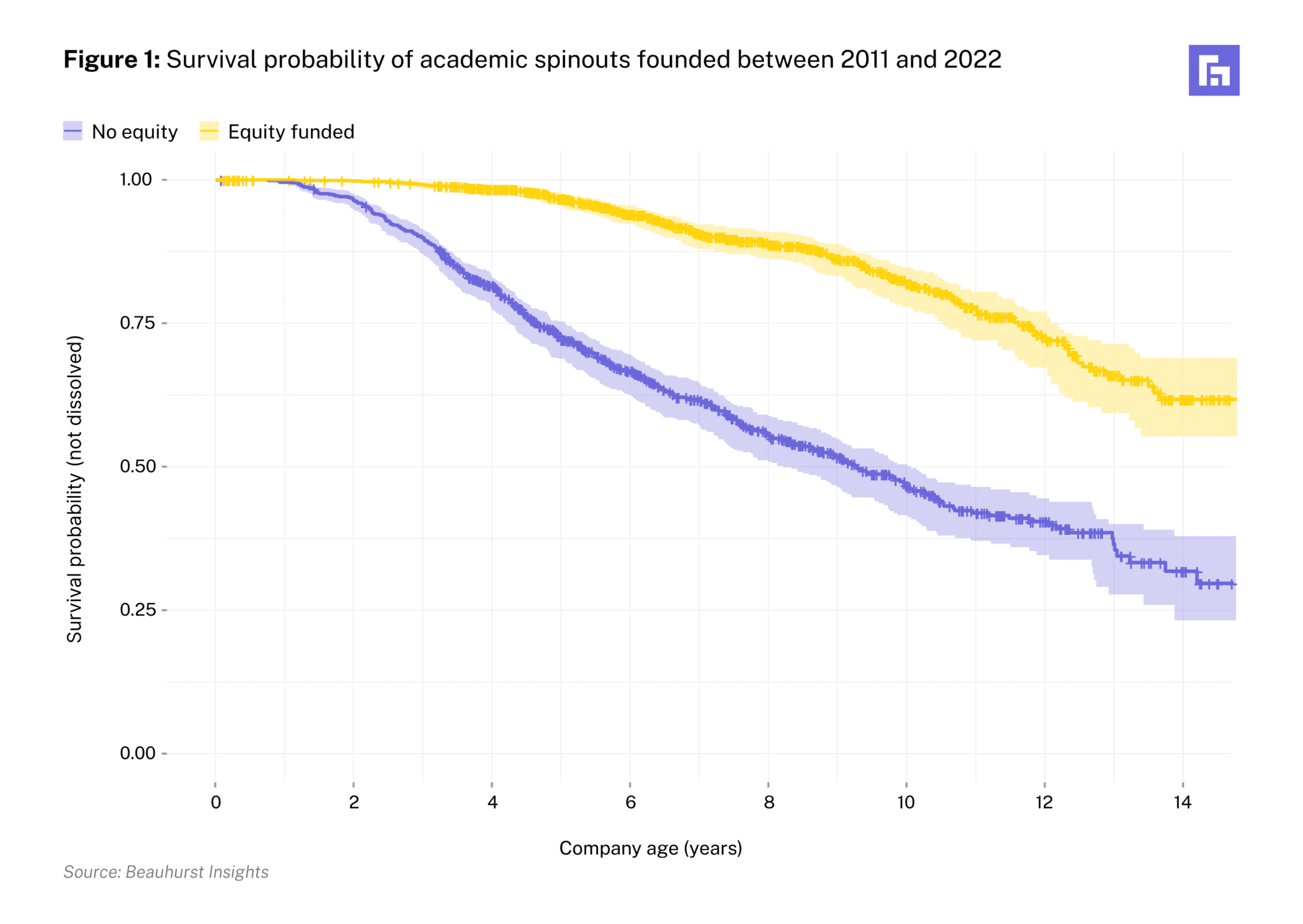
The Beauhurst Insights team has analysed the data and found that UK spinouts which raise equity investment are significantly more likely to outlive their non-funded peers. As shown in Figure 1, spinouts which secured equity had a 95% chance of survival through to the five year mark, compared to a 75% survival likelihood among firms without investment.

The probability gap widens over time. Equity-backed firms have over an 80% probability of surviving for at least a decade, and nearly two-thirds likelihood of surviving fourteen years. In contrast, for non-equity-backed spinouts below the probability of survival to ten years is below 50% and only 32% to reach fourteen years.
line chart 1

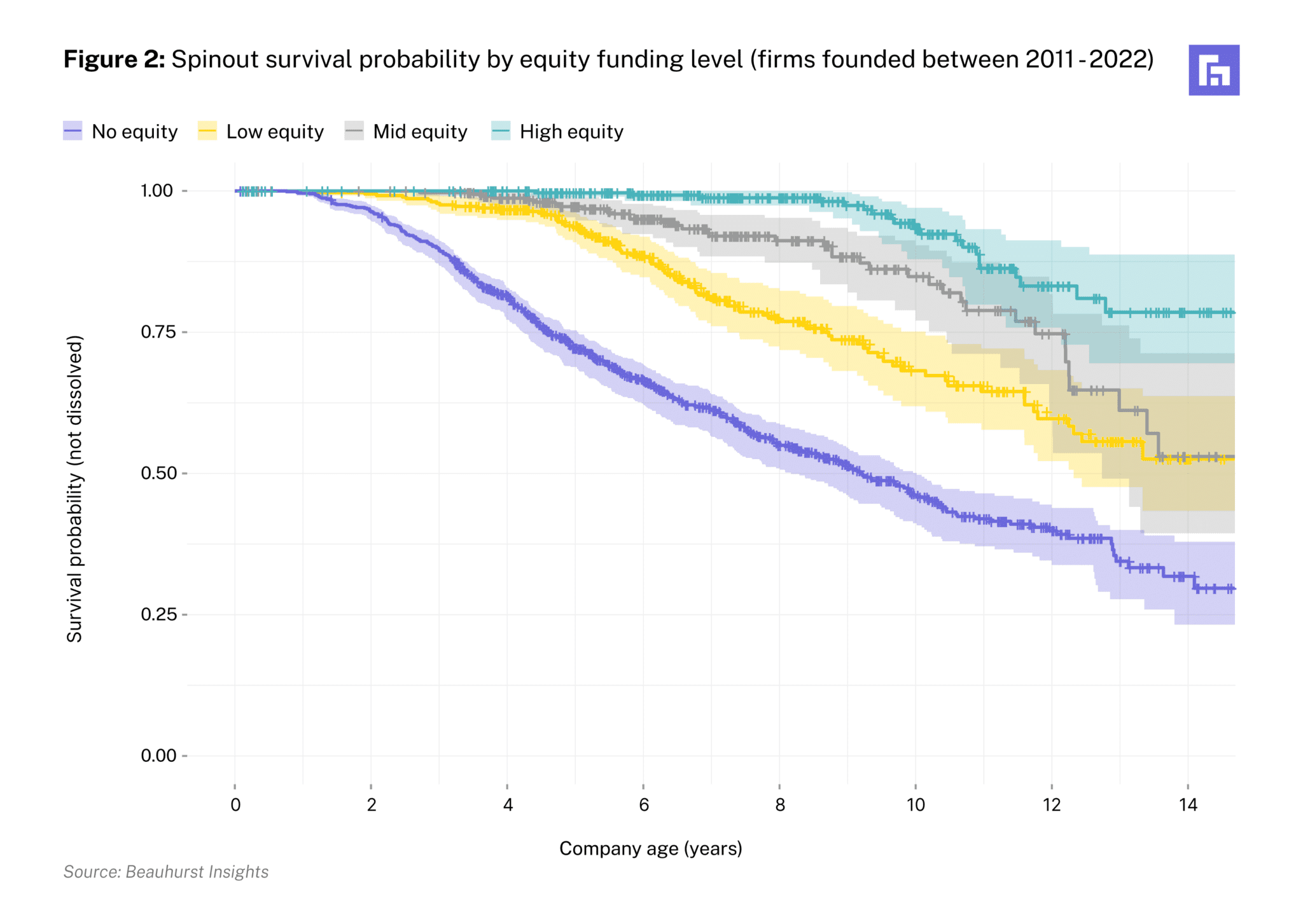
Although these figures may be reassuring for founders and funders, funding alone is not enough – it’s the value of that investment which is the key to long-term survivability. As shown in Figure 2, all equity-backed firms had almost the same five-year survival probability rate regardless of how much was invested. However, beyond this point things start to diverge sharply. By ten years spinouts which received a large amount of funding had a 94% survival probability. In contrast, companies which secured a smaller level of investment had only a 85% probability of survival.

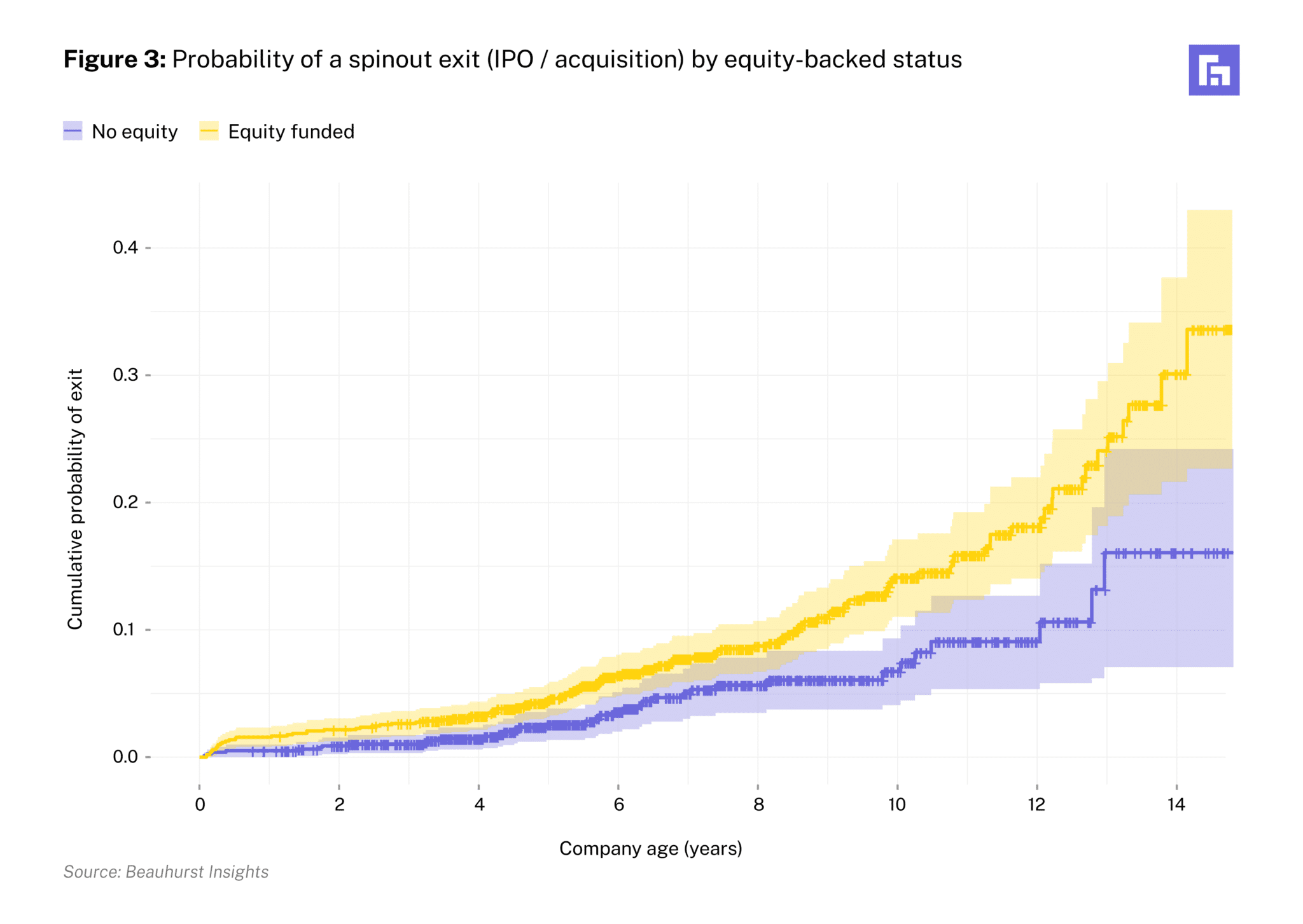
Companies can’t survive on investment alone, suggesting that those securing equity funding also tend to have stronger market propositions and are better positioned to capitalise on innovative ideas. As shown in Figure 3, equity-backed spinouts are consistently more likely to achieve a successful market exit than their non-funded counterparts. By the 14-year mark, they are twice as likely to have exited (e.g. through an acquisition or IPO) compared to non-funded peers.

In short, while any funding improves survival odds, the scale of funding becomes increasingly important over time.


line chart 2

Funding, selection bias and scaling UK spinouts

While correlation does not necessarily mean causation, the findings point to a clear relationship: spinouts that secure equity funding are consistently more likely to survive and succeed than those that do not. That said, an important caveat is the potential for selection bias. Investors tend to back the most promising companies, and in doing so aim to further reinforce their chances of success.

Even with this in mind, access to investment appears to play a critical role in shaping spinout outcomes, and improving access to finance will likely strengthen the UK’s ability to scale its most innovative businesses. Recent efforts by Innovate UK to strengthen links between founders, universities and funders are certainly a step in the right direction.

Ultimately, if the UK wants to move beyond being an “incubator economy” it needs to ensure its most promising companies can scale – not just start – at home.

Want to discuss the data? Drop me a message: callum.newton@beauhurst.com

Subscribe to the Beauhurst Insights Substack

Data-led analysis of the UK’s private companies, straight to your inbox.

Subscribe
Discover our data

Get access to unrivalled data on all the companies you need to know about, so you can approach the right leads, at the right time.

Book a demo today to see all of the key features of the Beauhurst platform, as well as the depth and breadth of data available.

An associate will work with you to build a sophisticated search, returning a dynamic list of organisations that match your ideal customer profile.