Are UK Business Owners Leaving the Country?

Words Callum Newton

Are UK Business Owners Leaving the Country?

Recent media coverage has increasingly focused on how business owners are relocating away from the UK following last year’s Autumn Budget. Over the weekend, Rathbones’ Head of Private Office told the FT that the wealth manager is “talking to more individuals and families – particularly younger business owners – considering relocation in search of better opportunities, more favourable tax environments and more optimism about long-term growth prospects”.

In recent months, we’ve seen stories of Revolut’s founder Nikolay Storonsky, Goldman Sachs’ Richard Gnodde and Sygnia Asset Management’s Magda Wierzycka all moving abroad due (in part) to Labour’s policies around ‘non-doms’, capital gains and inheritance tax reliefs. The Shadow Business Secretary went as far as to claim the Government has created a “hostile environment for wealth creators”.

While few would agree with Trade Minister Douglas Alexander’s optimism that “Britain is back and open for business”, the Beauhurst Insights team with our colleagues at Rathbones wanted to test whether the anecdotes actually stack up with data trends.

What the data says about business owners leaving

It was one of perhaps the world’s most famous business leaders – Jeff Bezos – who coined the term “when the data and the anecdotes disagree, the anecdotes are usually right”. There’s a reason he’s one of the richest men in the world.

Since January 2024 5,940 ‘People of Significant Control’ (PSCs) have left the UK and moved abroad. Coinciding with the stereotypes, the low/no-tax UAE (home to Dubai and Abu Dhabi) was the most popular destination for PSCs followed by long-term favourite of British expatriates, Spain (Figure 1). There were also a large number of PSCs who relocated to the United States, suggesting business leaders may prefer Trump’s America to Starmer’s Britain.

But what about the arrivals? Over the same period only 3,182 PSCs moved to the UK from abroad. In fact, only four countries were major net importers of PSCs, including Pakistan and Turkey. Overall this means for every new PSC arrival, 1.87 left the country. This shouldn’t come as a huge surprise to readers as ONS figures suggest we are experiencing a large shift towards emigration – particularly amongst younger generations.
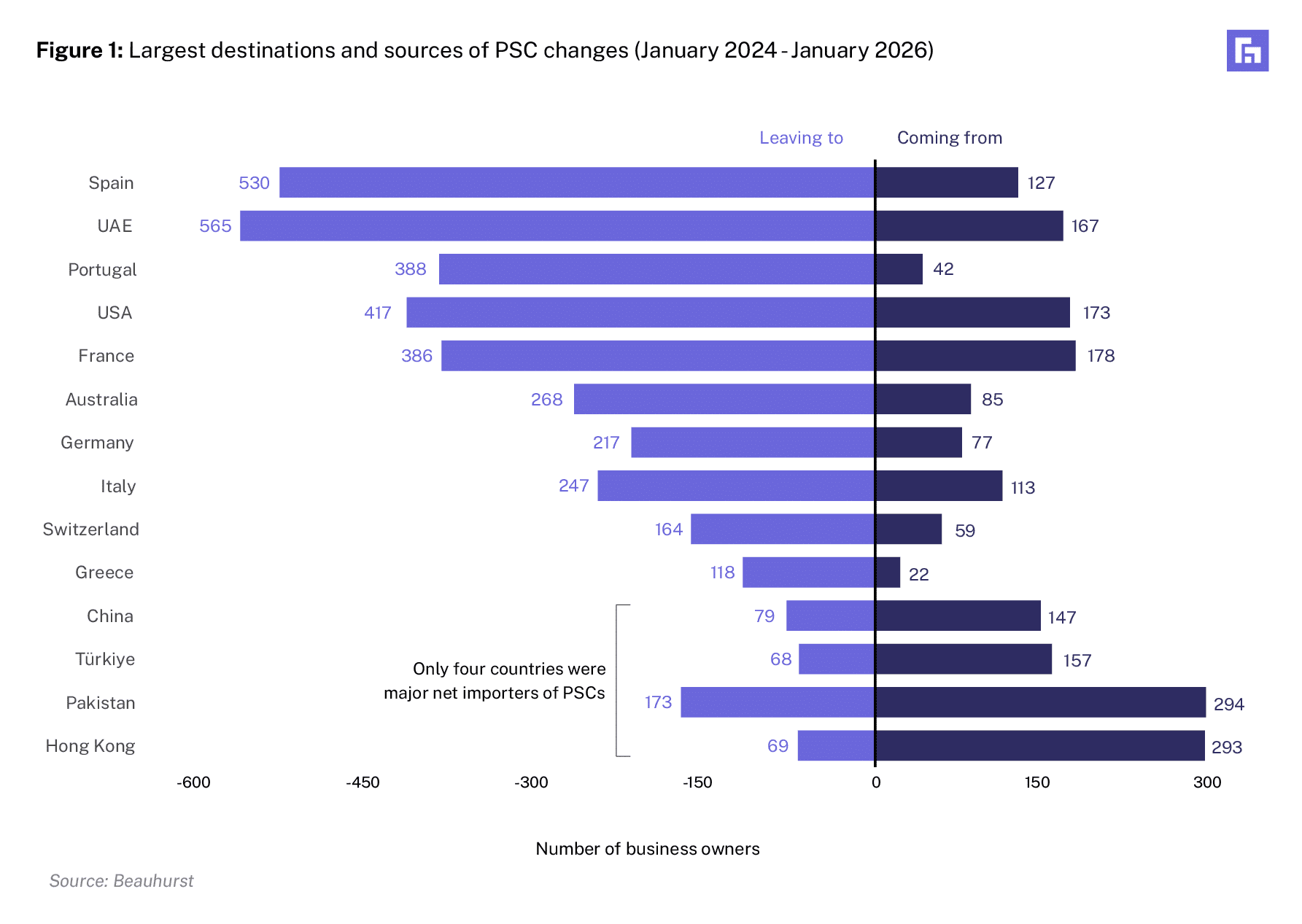
bar chart 1

It is important to note that the Beauhurst Insights team’s analysis focuses on PSCs rather than company directors. A PSC refers to an individual (or legal entity) who controls or owns a company, such as by holding more than 25% of shares or voting rights, having the right to appoint or remove a majority of directors, or otherwise exercising significant influence or control over the company. Whereas a business director is a person legally responsible for managing the company’s affairs, but is not necessarily an owner of the company.

This distinction may appear trivial, but it is important. PSCs are the ultimate beneficiaries of business activity, and are crucially the engines of growth across the British economy.

Where the PSC exodus hits the UK economy hardest

Ok so we know the macro-level picture looks gloomy, but what does this trend of PSCs moving abroad mean for the British economy?

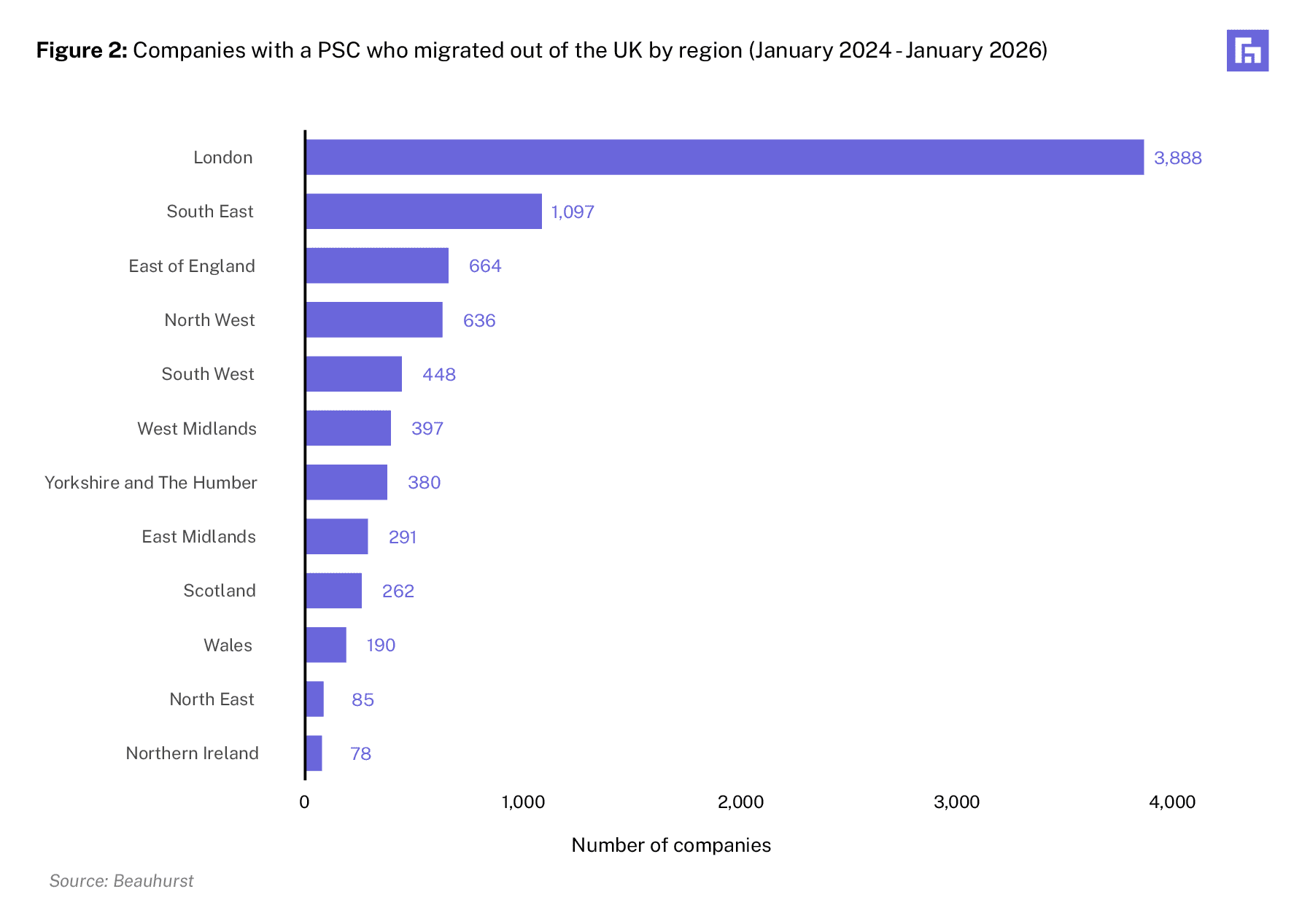
For starters this problem appears to be directly impacting businesses in the economic heart of the country. The UK has one of the most centralised economies in Europe and is heavily reliant on the City of London and the Home Counties to stay fiscally afloat. It is therefore alarming to hear that together companies across London and South East England accounted for two-thirds of total PSC departures. To put this in perspective, the UK’s devolved nations of Scotland, Wales and Northern Ireland accounted for only 6% of departures.

In fact, just three London Boroughs – Westminster, Camden and the City of London – account for a fifth of all affected businesses. Analysis by the Beauhurst Insights team also shows that, of the twelve local authorities with the highest number of firms whose PSCs have moved abroad, only Manchester and Leeds are located outside London.

bar chart 2

This issue disproportionately affects parts of the economy that are critical to breaking Britain’s growth “doom loop.” It is no accident that technology sits at the heart of the UK’s Modern Industrial Strategy. London has been a global centre of commerce for centuries, and Britain – once the cradle of the Industrial Revolution – has been at the forefront of world-changing innovations, from the jet engine and penicillin to the World Wide Web.

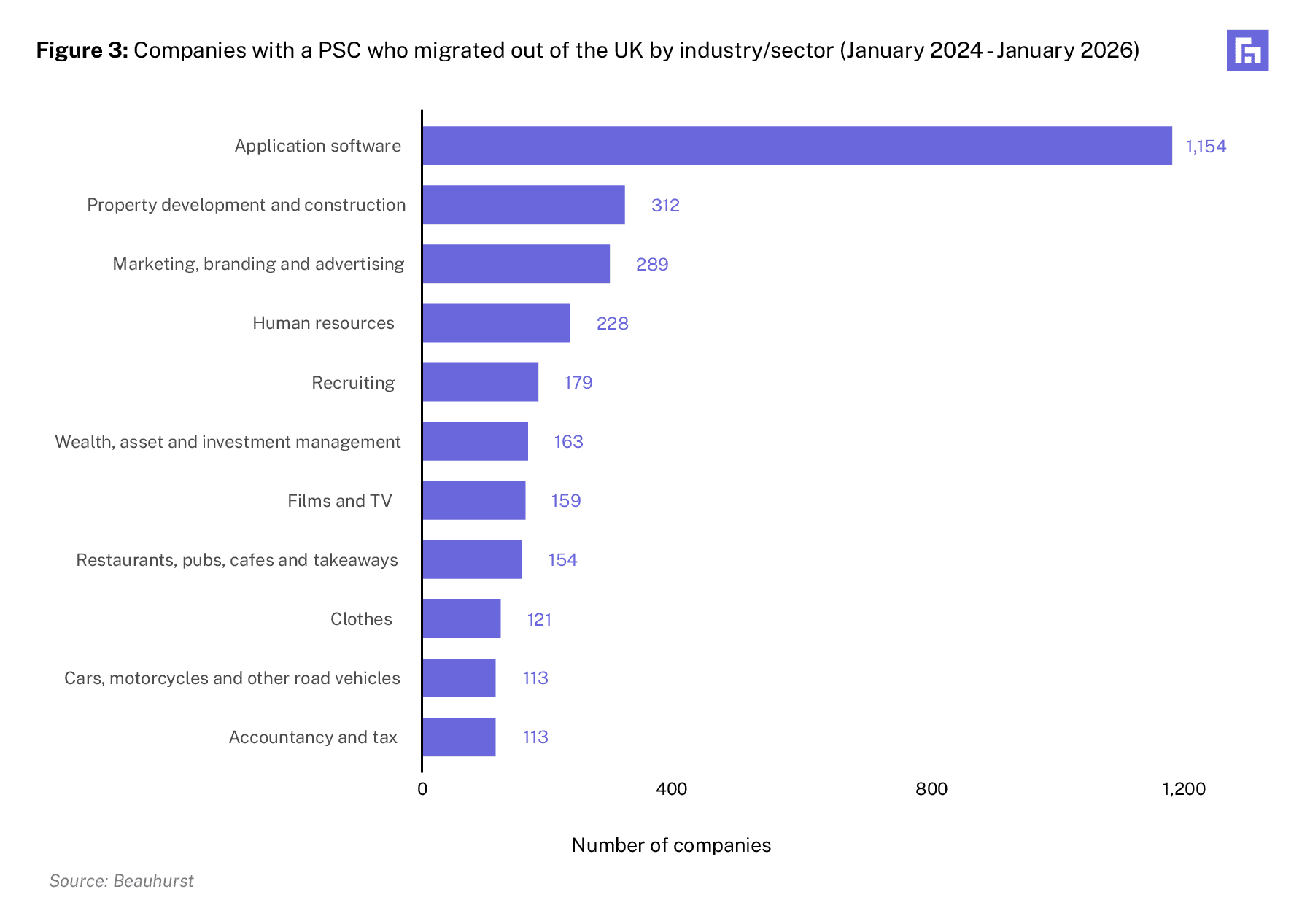
Unfortunately, the sector has been particularly exposed to this issue. Software businesses alone account for over 10% of companies where a PSC has relocated overseas in the past two years. This is especially significant given that application software firms generate 7.6% of national business turnover and account for 23% of Britain’s high-growth companies.

bar chart 3

Although the Government has announced a revamped Office for Investment and rolled out a new taskforce to solidify Britain’s ‘position as the first choice for the world’s brightest sparks’, the latest PSC trends paint a far gloomier picture for ‘Global Britain’.

While it’s clear the UK is still managing to attract some PSCs from around the globe, the domestic market looks increasingly uncertain. Recent survey research conducted by Rathbones found that one in eight business owners are planning to relocate out of the UK due to the Government’s new tax proposals. With shaky public finances, sluggish growth and an uncertain tax regime, we may see the gap between PSC arrivals and departures widen in the years ahead.

Want to discuss the data? Drop me a message: callum.newton@beauhurst.com


Subscribe to the Beauhurst Insights Substack

Data-led analysis of the UK’s private companies, straight to your inbox.

Subscribe
Discover our data

Get access to unrivalled data on all the companies you need to know about, so you can approach the right leads, at the right time.

Book a demo today to see all of the key features of the Beauhurst platform, as well as the depth and breadth of data available.

An associate will work with you to build a sophisticated search, returning a dynamic list of organisations that match your ideal customer profile.