Change. The word on the minds of millions of people up and down the country in 2024, and at the forefront of Keir Starmer’s campaign to build “a fairer, healthier, a more secure Britain” after 14 years of Tory rule. The country was tired of the Conservatives, and delivered Starmer one of Labour’s largest ever parliamentary majorities (albeit with only a third of the popular vote). But two years later he’s out of office and many voters now feel short changed.
It’s too soon to say what Starmer’s legacy will be. It could be the Online Safety Act, renationalisation of Britain’s railways or the abolition of Hereditary Peers. It could also be his u-turns around welfare reforms, his appointment of Peter Mandelson or his decision to (sort of) keep Britain out of America’s war with Iran. But how has the economy performed? This week the Beauhurst Insights team wanted to measure the financial, investment and innovation trends of the UK’s business landscape over Starmer’s premiership and how he stacks up against his predecessors.
Company and sector growth under Starmer
Let’s start with the good news. The number of active companies operating across the UK has grown since Starmer took office. London is the real winner, with a six percent bump in the number of companies setting up shop in the capital since the election. But this uptick doesn’t appear to be limited to London. At the economic polar opposite of the country, Beauhurst have recorded similar spikes in company headcount in Scotland (+6%) and the author’s native North East (+6%).
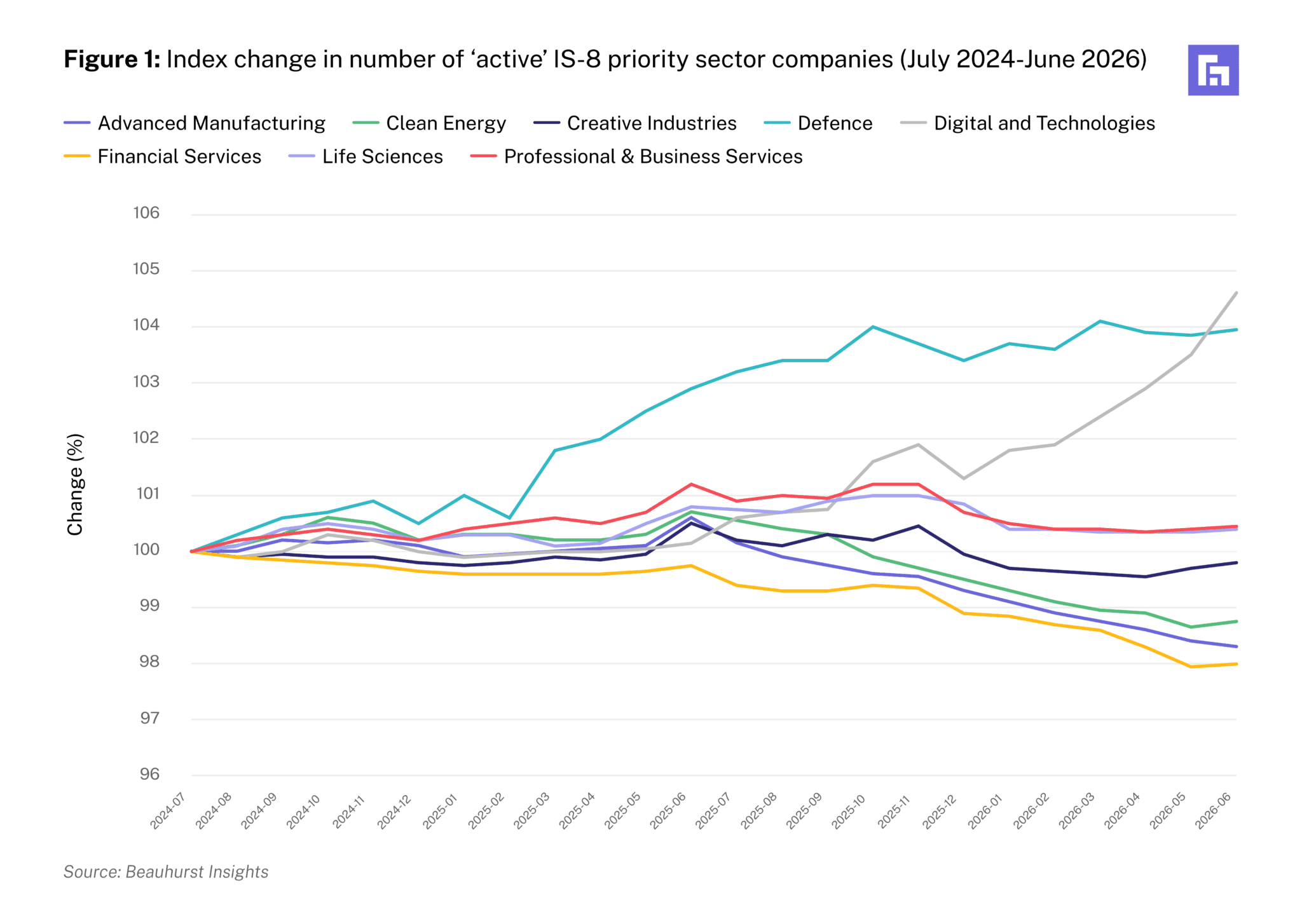
There also appears to be some positive headwinds in some of the priority sectors outlined in the UK’s new Modern Industrial Strategy, particularly in relation to Digital and Technologies (+5%) and surprisingly Defence (+4%) a sector whose failed investment plan was the final straw for his premiership (Figure 1). However, beyond these two sectors little has changed, which is to be expected as the plan was only launched mid-way through his time in office.