There’s rarely been a tougher time to be a council leader in the UK. Real-term budget cuts, growing demand for public services and uncertainty around Local Government Reorganisation (LGR) have created a perfect storm around many council’s ability to deliver meaningful change to their communities. And their voters are noticing.
Earlier this year, polling found that only half of British adults are satisfied with how their council is delivering services (down from 75% during the pandemic) and the number of people who don’t trust their council has overtaken those who do for the first time since 2013.
This is why economic development is crucial to getting many councils out of their financial woes. Introducing policies designed to support local companies growth also helps council coffers grow over the long term, through more business rates revenue and creating more jobs to reduce unemployment. But right now it’s hard for many economic development teams to know where to prioritise resources, what their comparative advantage is and how they stack up against their neighbours.
The geography of growth
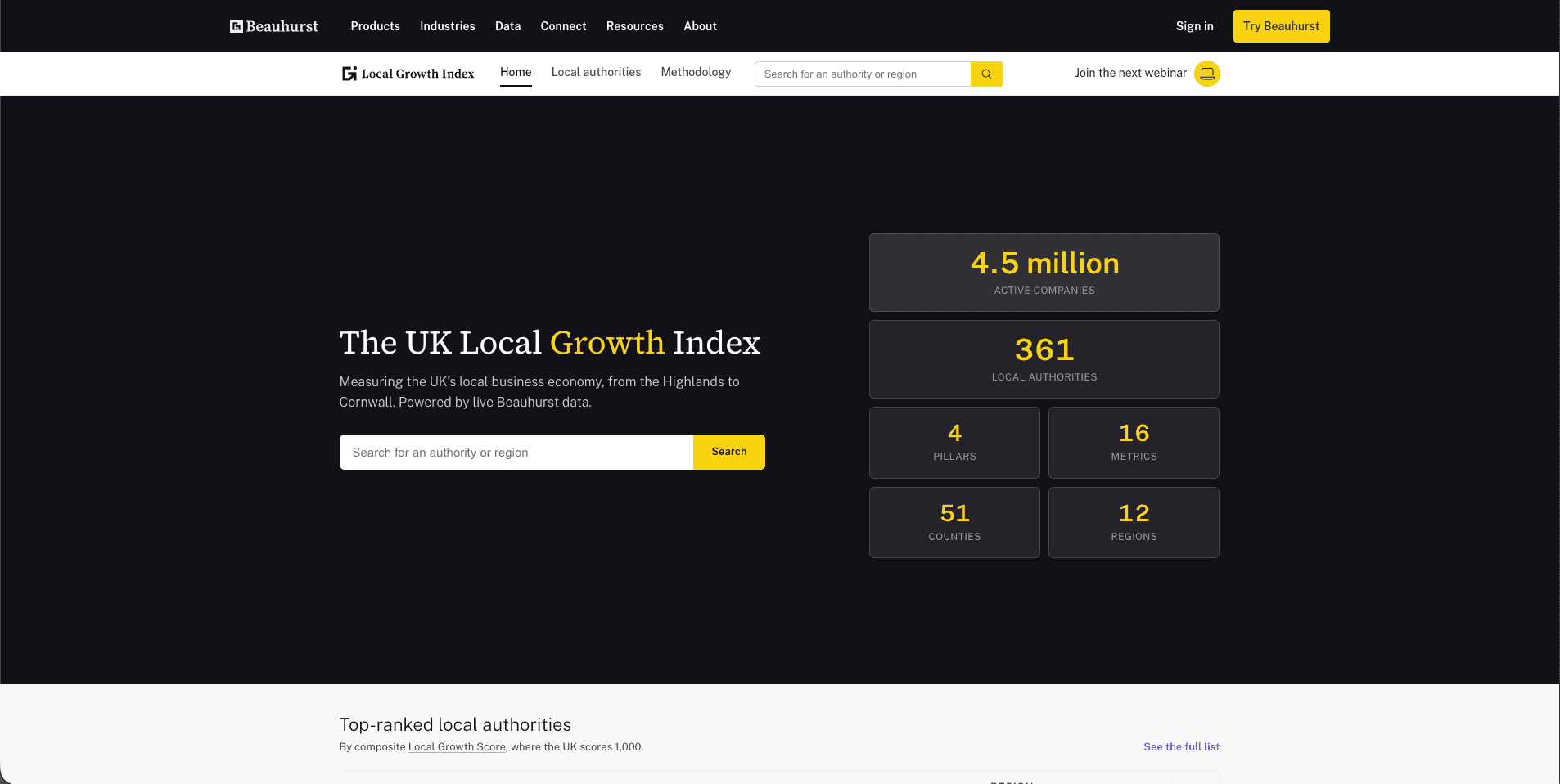
This is exactly the problem we’ve been looking to address with Beauhurst’s new Local Growth Index (LGI). Drawing on data from 4.5 million active UK companies, we’ve measured business activity within 361 local authorities against 16 different measures spanning four key pillars of economic activity (innovation, scaling, investment and ESG).
Crucially we wanted to build something a bit different. Instead of measuring raw aggregate values, Beauhurst’s Index looks at the intensity of business activity relative to the number of active companies in each area. This allows us to compare local authorities on a more equal footing, rather than simply rewarding those with the largest business populations or the most investment. So what have we found?