An unannounced fundraising is simply an investment made in to a private company that is not announced to the public. These transactions are an integral part to understanding the beginnings and continued growth of some of the largest companies in the UK. Deliveroo, BenevolentAI and Wise, some of the UK’s most valuable private companies, all started their funding journeys with unannounced raises.
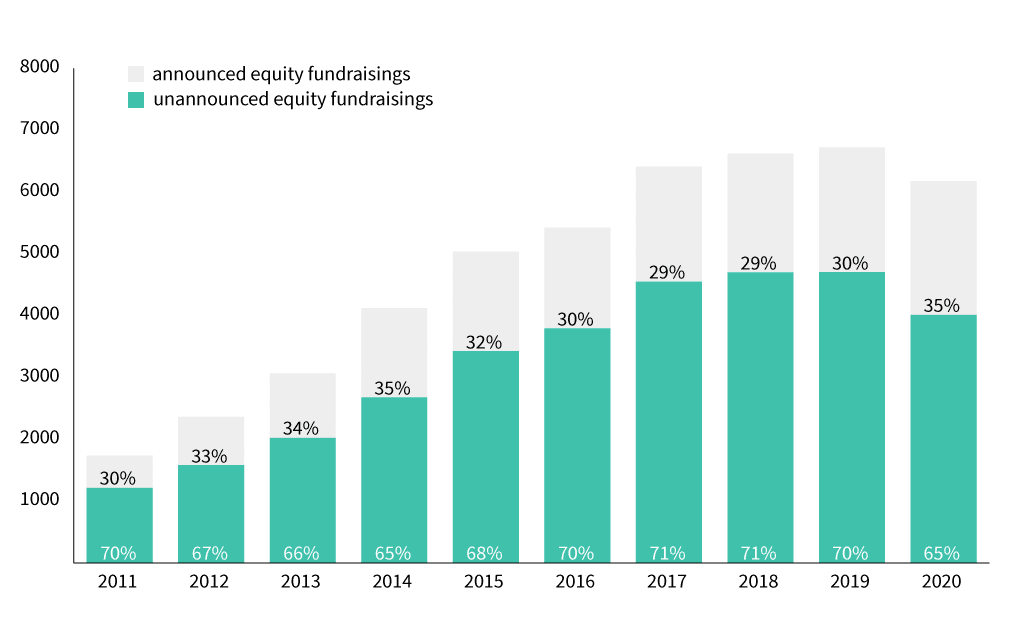
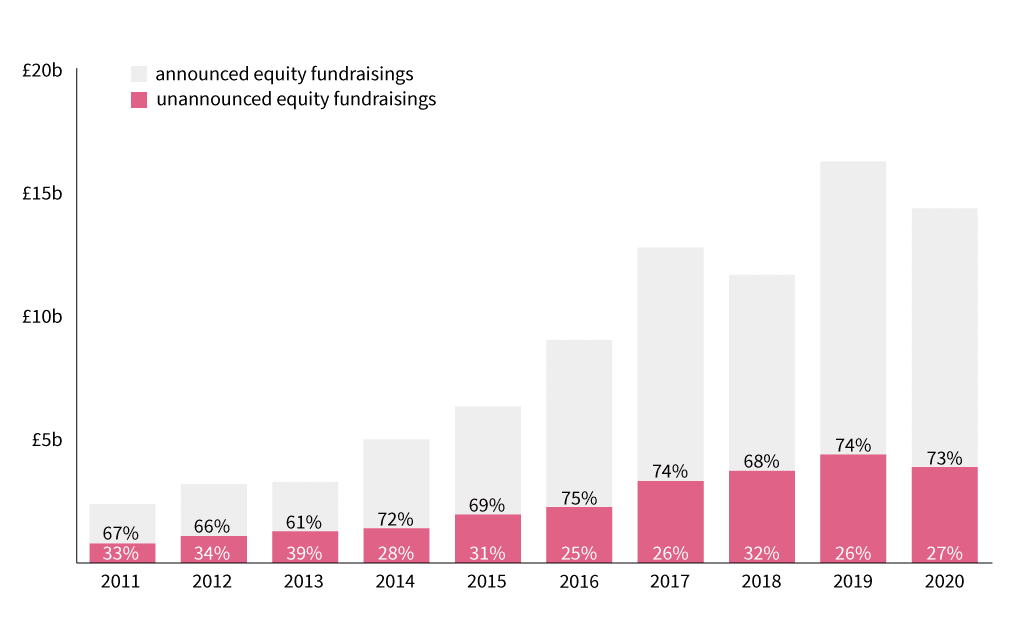
We currently track over 7,300 companies on the Beauhurst platform that have raised equity funding and never announced it to the public. In 2020, 65% of equity deals were not announced to the public, and there have only been small fluctuations in this figure since 2011. In terms of pounds invested, however, 73% were announced.
Although under-the-radar funding rounds are, on average, significantly smaller than those shared with the media, they can be just as interesting—if not more—and signal that a much larger event is on the way. You can check out our 2020 report, The Stealth Round, for further information on unannounced fundraisings.
How do we source this data?
Beauhurst is the only data provider to have comprehensive and structured coverage of unannounced investment deals in the UK. Using proprietary technology, we monitor all SH01s (forms that companies submit when they wish to issue new shares) filed to Companies House. Sometimes, these may not show genuine investment, so we’ve built an algorithm to pick its way through the minefield and flag up any filings that do. Then, a member of our in-house Data team investigates and verifies if a new investment has been made, and uploads the data to the Beauhurst platform.
SH01 filings may not show genuine investments for several reasons, such as the exercise of employee options, restructuring shares to make the capitalisation table look tidier for accounting purposes or because the company paid for services in shares, rather than in cash.
Why might a company want to keep their funding under wraps?
On the one hand, a company may choose to announce their fundraising as it’s an exciting achievement worth celebrating, and acts as an external validation of its ambitions. This may result in increased press coverage, and hence lead to new business or opportunities. An equity funding round is a particularly notable event if it includes participation from high-profile funds, such as Accel, Index Ventures or Octopus Ventures.
It’s also worth noting that some rounds need to be announced to the public. For example, almost every round that’s completed via crowdfunding is announced (and in some cases, very heavily publicised, like Citymapper’s recent raise via Crowdcube).
On the other hand, a business may choose not to announce their fundraising for a number of reasons:
- The company lacks the resources to successfully promote their raise to the media
- The company doesn’t think it’s relevant to promote the funding round
- The company is hiding a down round—an investment deal in which shares are sold for a lower price than in the previous funding round
- The company is in “stealth mode” and trying to stay under the radar
- The funding round is a precursor to a more significant event, such as an IPO, crowdfunding round or large investment deal that the company doesn’t want to hint at
Investment numbers
Even though the number of equity deals completed in the UK has increased significantly since 2011, the percentage share of unannounced fundraisings has remained fairly steady, fluctuating between a low of 65% in 2014 and a high of 71% in 2017 and 2018. This indicates that filings are not disclosed to the media for systemic reasons, rather than being swayed by the economic climate.
In 2020, just 65% of deals went unannounced to the public, but this figure may rise as late filings are submitted to Companies House.
total Number of UK equity deals and percent unannounced by year